
Every Identity Governance & Administration implementation reaches the same point eventually.
The IGA platform is live. Core connectors are in place. JML flows are running. The implementation was solid. But most of the client's application estate is still being provisioned manually. Custom-built tools, legacy systems, SaaS applications without SCIM support, shadow IT — everything that didn't make it into the original connector scope is still on a helpdesk or 'app owner' queue if known at all.
At some point, the client starts measuring outcomes. And the call comes in.
Your clients know this. You know this. The question has never been whether the gap exists. It's been what to do about it because until now, the options weren't good.
Why the gap has been hard to close
Native connector development moves at the IGA vendor's pace, not your client's. For the most common enterprise applications, that works. For the rest of the estate, the wait is measured in quarters, not weeks, and coverage for niche or custom applications isn't guaranteed at all.
Custom connector development fills some of that gap, but it's expensive, maintenance-heavy, and doesn't scale across a client base. Each connector is a bespoke project with an ongoing maintenance obligation attached to it. Neither option keeps pace with how enterprise application estates actually grow.
The gap isn't a backlog you can clear. It's a moving target.
What's changed
AI didn't just add more identities to govern. It also created the opportunity for technology capable of keeping up with the pace at which enterprise application estates grow — exactly what StackBob was built for. As an Agentic IGA solution, StackBob closes the connectivity gap by extending what your client's existing IGA platform can reach.
Where a target application lacks SCIM, a native API, or a native connector, StackBob's proprietary No-Code Autonomous Provisioning (NCAP™ ) technology steps in. It receives provisioning requests directly from the upstream IGA platform and handles the full interaction with the target application, including ongoing reconciliation.
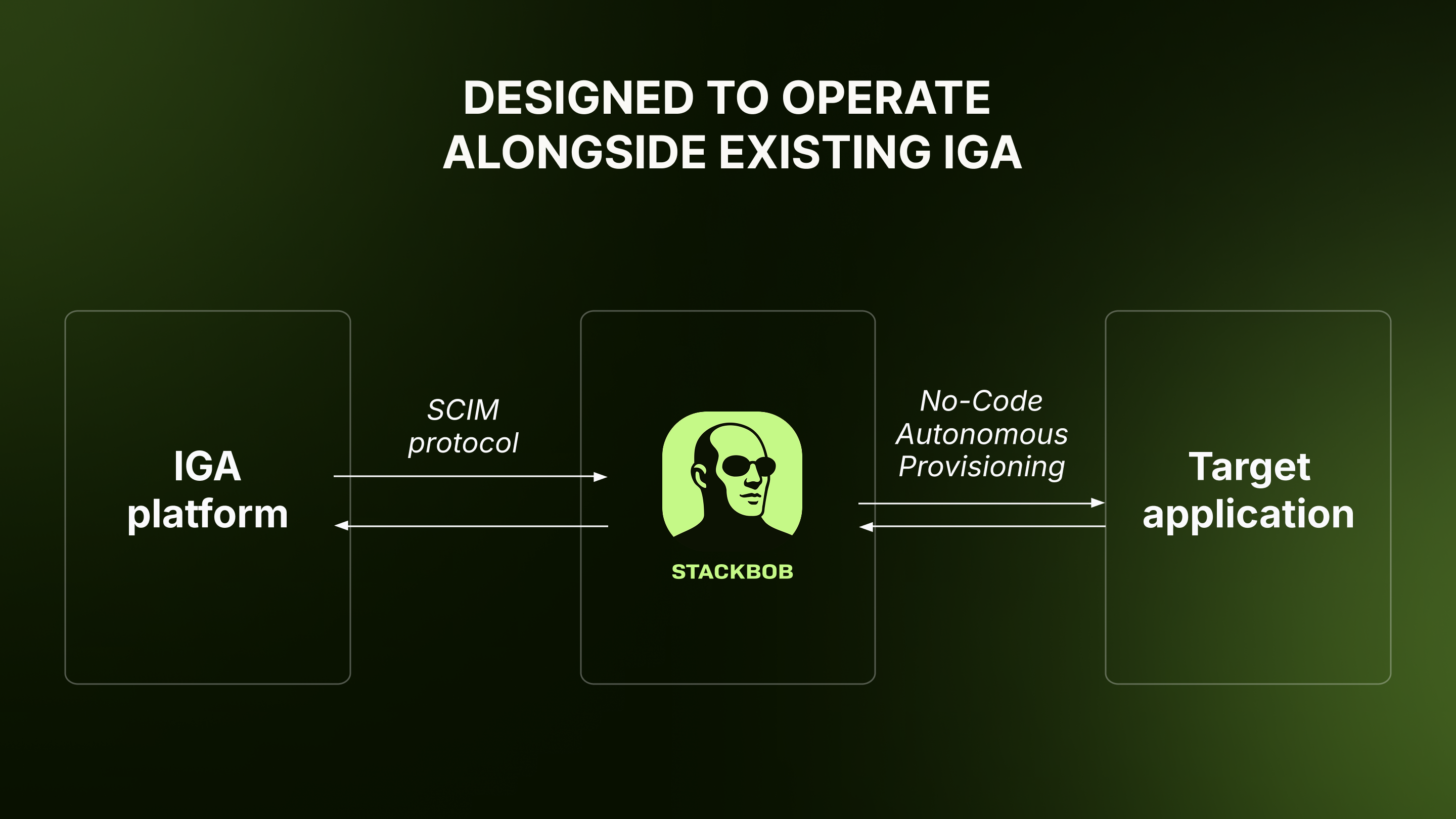
In practice, a typical application connects in under 48 hours without custom development or additional engineering scope from your team. The target is 90% application coverage as a baseline, not a ceiling. For your clients, the transition is incremental: there is no migration, no re-architecture, and no disruption to the program already in flight.
What that means for your practice
Being the team that has a deployable answer to close the coverage gap opens three things:
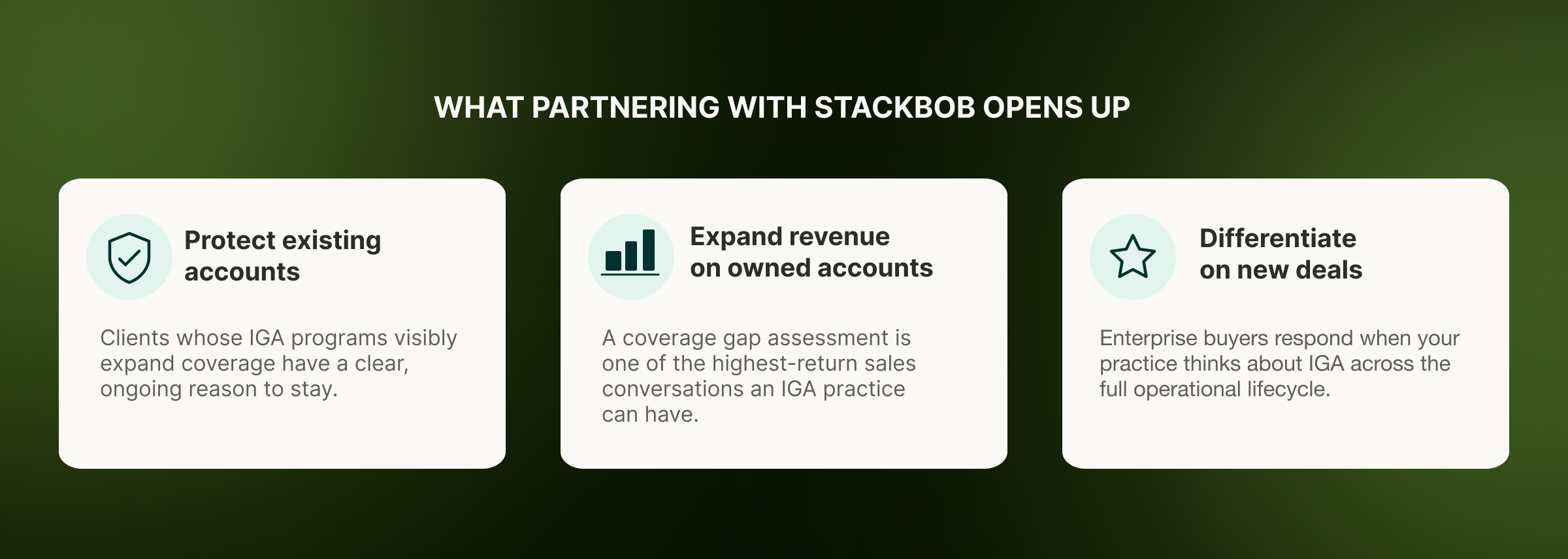
Path to protect existing accounts
Clients whose IGA programs are visibly expanding their governance coverage — reaching more applications, reducing manual overhead, improving audit results — have a clear, ongoing reason to stay. The coverage gap, left unaddressed and unquantified, is one of the most common sources of attrition in IAM practices not because the work was poor, but because the value stops being visible after go-live.
Revenue expansion on accounts you already own
The client relationship exists. The IGA platform is deployed. The ungoverned application tail is visible and quantifiable. A coverage gap assessment — run across your active client base with a financial framework already in hand — is one of the highest-return sales conversations an IAM practice can have. You're extending the value of work already done, not proposing a new project.
Differentiated position on new deals
Walking into an IGA implementation conversation with a coverage gap framework and a concrete answer for how you close it is a different kind of proposal than a methodology comparison. It demonstrates that your practice thinks about IGA programs across their full operational lifecycle, not just the implementation phase. Enterprise buyers respond to that distinction.
Partnering with StackBob
The coverage gap is not a problem that resolves itself as IGA programs mature. Application estates keep growing and the gap keeps widening. And StackBob is a sophisticated answer for it, taking our partners in a fundamentally different competitive position from those that don't.
StackBob partners get more than a technology to resell. From day one, you receive a client-facing TCO framework — a structured five-year cost model that quantifies the gap across internal resource overhead, audit findings, and access delay productivity loss. Partners adapt it to a specific client environment (user count, application estate, current governed coverage) and it produces a defensible cost estimate in under an hour. Alongside that, you get a deployment model that requires no re-architecture of programs already live, and direct access to the StackBob team to support scoping, client negotiations, and technical questions as they come up.
Each application connected extends governance coverage, reduces your client's operational overhead, and deepens the value your practice delivers over the long term. That's what a strong partner relationship looks like in practice: not a one-time deployment, but an ongoing program that keeps growing alongside your client's environment.